Since the energy crisis of 2022, Europe has redefined why it supports hydrogen. Initially promoted mainly as a way to decarbonise sectors that are difficult to electrify, hydrogen is now also presented as a means to reduce dependence on imported fossil fuels and strengthen long-term energy security. As Europe accelerates its shift towards domestic renewable energy, governments continue to view hydrogen as an important complement to direct electrification, particularly in sectors where electrification remains difficult or costly.
Spain has more sun and wind than almost any other country in Europe, and an industrial base that already uses hydrogen at scale. It is one of the continent’s few countries that could become a regional hydrogen exporter, capable of producing more hydrogen than it needs at competitive costs.
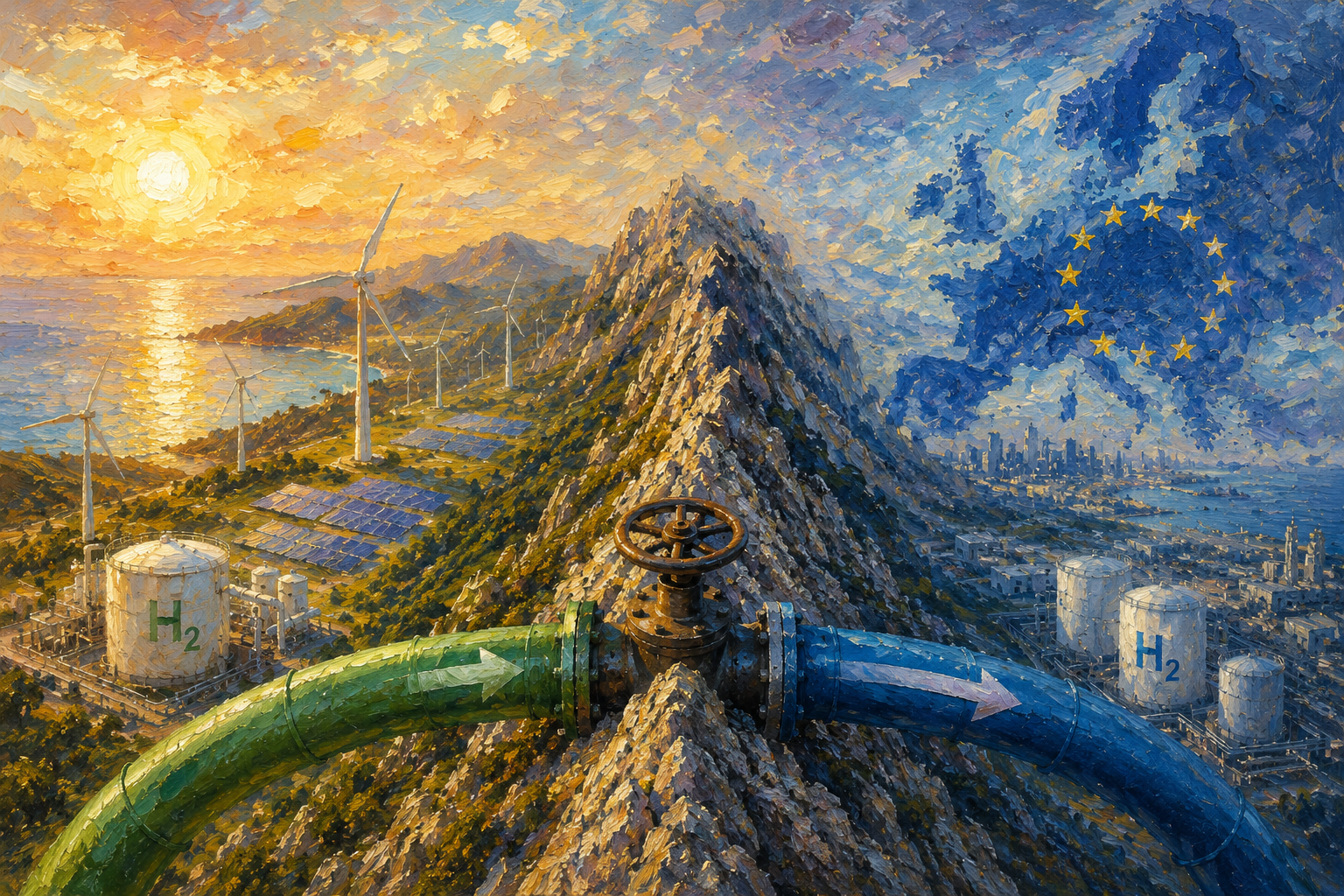
Yet the biggest threat to that ambition is a stretch of mountains separating Spain from the rest of Europe, and a neighbour unsure about whether hydrogen should cross them.
After 2022, Europe changed its view on hydrogen
For our latest study, we wanted to find out whether Russia’s invasion of Ukraine and broader weaponisation of energy exports to Europe have decisively changed the way European policymakers think about energy, especially renewable energy and hydrogen.
What we found from reading nearly 3,000 pages of hydrogen strategies from the European Commission and eight Member States is that what governments aim to achieve with hydrogen has changed. Before the war, security appeared in less than one in five statements about policy goals (19%). After the war, every one in four statements was about security (26%).
How governments try to meet their goals has changed as well. Every government has three basic ways to influence society. It can compel using “sticks,” reward with “carrots,” or persuade through “sermons.” Scholars call these “policy logics”. After the war, the sticks gained ground. Mentions of coercive policy logics, such as regulations and mandates, climbed from 17% to 23%.
Views on hydrogen’s role in the energy system also changed. European governments described hydrogen less as a rival to electrification in the hard-to-abate sectors, and more as a complement. They see hydrogen as a way to store renewable electricity for months at a time, allowing it to back up the power system, as well as the core ingredient for clean, liquid transport fuels that could be produced locally to run everything from planes to tanks.
Spain bucks the trend
Spain occupies a different position in Europe’s emerging hydrogen economy. Its abundant solar and wind resources could allow it to produce large quantities of renewable hydrogen, while its refineries and chemical industries already provide substantial domestic demand. Spain, therefore, expects to use some renewable hydrogen at home and export some to industrial centres elsewhere in Europe, particularly through the planned H2Med corridor.
Against this background, Spain bucks the broader policy trend. While almost every government in our sample placed much greater emphasis on security after 2022, broadly aligning with the European Commission, Spain changed its narrative relatively little. It also moved away from mandates and obligations, relying more heavily on incentives (“carrots”) and persuasion (“sermons”). This may reflect Spain’s expected position as a major producer and exporter, rather than primarily as an import-dependent consumer. But its export ambitions depend on neighbouring countries supporting the necessary pipelines and on sufficient demand emerging elsewhere in Europe.
A market that stops at the mountains
In our study, we also mapped the strategic priorities of key Member States around hydrogen’s international dimension. As the figure shows, these priorities are clear in almost every country except one.

At first, the match looks promising. Aligned with their abundant renewables, Portugal and Spain want to sell hydrogen to the rest of Europe. They will find governments that see hydrogen imports as a strategic priority, such as the Netherlands and Germany. On paper, exporters in the South and importers in the North complement each other, paving the way for a potential internal hydrogen market in Europe.
But a market needs a road between buyer and seller. Hydrogen transport is the key missing piece. While both potential exporters and importers of hydrogen rank transport as a high priority, the country separating them, France, does not.
France shows the lowest interest in hydrogen transport in our entire sample. Its central geographic position between potential exporters in the Iberian Peninsula and potential importers in north-western Europe turns the French position into a bottleneck for European hydrogen trade. As such, geography turns France’s priorities into a European problem.
When every country wins, Europe loses
Since the energy crisis, the European Commission and most Member States have moved in the same direction: more security goals, more coercive logics, and more attention to how hydrogen and electricity can work together. Europe seems united. Coming one step closer, the picture is more complicated.
The differences are less about the broad direction than about the details: which goals matter most, which tools to use, which sub-sectors to focus on, and which pipelines to build first. And it is in these details where the European hydrogen market is either made or missed.
Consider where each country’s own interest leads. France has little to gain from carrying another country’s hydrogen across its territory, so it feels little urgency to build the link across the Pyrenees. Spain, rather than send its hydrogen north, could welcome the industries that need it to come south instead. If exporting the fuel is too difficult, Spain could try to import the industries using it. However, these individual interests may not add up to a truly European strategy.
If France drags its feet, industrial incumbents in Northwest Europe may never receive the cheap, clean feedstocks they need to survive. In the attempt to move industries within Europe, some may get lost along the way or choose to relocate outside the EU altogether.
This is the broader lesson in how hydrogen policy has changed. Europe did not abandon its climate ambitions after 2022; it reframed them as part of a security and competitiveness agenda. The same technologies once promoted as solutions for a warming planet are now promoted as safeguards for turbulent times. But a safeguard is stronger when built together. Hydrogen is most likely to strengthen Europe’s security if it is treated as a common interest rather than another focus of internal competition. This depends on whether Europe can look beyond national borders and set its gaze higher than the mountains that lie in between.
***
James Kneebone

About the authors: James Kneebone is a Doctoral Researcher in the Group for Sustainability and Technology at ETH Zürich, focusing on European hydrogen, energy, and industrial policy. He was previously a Research Associate at the Florence School of Regulation, working on EU hydrogen financing, justice in renewable hydrogen value chains, and energy security. Before this, he worked in DG ENER at the European Commission on security of energy supply and the EU Methane Strategy. James holds an MSc in International Development from Utrecht University and a BSc in Liberal Arts and Sciences from University College Maastricht.
Alejandro Nuñez-Jimenez

About the authors: Alejandro Nuñez-Jimenez is a Research Group Leader and Principal Investigator in the Chair for Sustainability and Technology at ETH Zurich, and an Associate at the Belfer Center at Harvard Kennedy School. Their research focuses on energy policy, innovation, agent-based modelling, and energy system modelling. They teach Energy Innovation and Management at Master’s level at ETH Zurich and serve as Academic Editor at PLOS Climate. They are the recipient of a Swiss National Science Foundation Ambizione Grant for the Zero-AMPS project. They completed their PhD at ETH Zurich, hold degrees from EPFL and UPM, and have worked in the solar industry in Madrid and Dubai.
Deja una respuesta